Blog

How Soundgarden’s Louder Than Love Inspired the Cover of Kato

We took a lot of our design inspiration from album covers, and as you can see Soundgarden’s Louder Than Love was a big reference point. I bought the album on vinyl when it came out in 1989, but it looks like one of my kids “borrowed” it at some point…

This cover is an especially appropriate influence for Kato, which is set in Seattle in the late 90s.

Learn more about Kato

Mac 512

I wrote these stories on a Mac 512 between 1990 and 1994. They were saved on floppy discs and printed out on a dot matrix printer. 

I’ve always considered the design of these early Macs to be absolutely iconic. I recently discovered that mine is still in the shed at my parents’ house, yellowed with age. 

This little “Maclock” came into my feed the other day. I usually avoid buying this kind of crap but I couldn’t resist this time. It’s surprisingly accurate. And it’s darn cute.

Learn more about Stories

Italo Calvino on Writing and Memory

In getting ready to publish Firenze, I revisited some of my favorite Italian writers, including Italo Calvino. I picked up a copy of his first novel The Path to the Spiders’ Nest and was particularly struck by a few passages in the the preface, which Calvino wrote years later when revisiting his early work.

What you read and what you experience in life are not two separate worlds, but one single cosmos. Every life-experience, in order to be interpreted properly, evokes certain things you have read and blends into them. That books always derive from other books is a truth which is only apparently in contradiction with the other truth, that books derive from practical existence and from our relations with other people.

There is another point: for those who start writing after one of those experiences that leave you with ‘so many things to say’ (the war in this, and in so many other cases), the first book instantly becomes a barrier between you and that experience, it severs the links that bind you to those facts, destroys your precious hoard of memories – a hoard in the sense that it would have become a reserve on which to draw permanently if you had been patient enough to husband it, if you had not been in such a hurry to spend it, to squander it, to impose an arbitrary hierarchy on the images that you had kept stored there, to separate the privileged images, which you believed contained a genuinely poetic emotion, from the others, those which seemed to concern you too closely or too little for you to be able to portray them; in short to set up in your arrogance a different memory, one that has been given another shape instead of your whole memory with its blurred outlines and its infinite capacity for retrieval… Your memory will never again recover from this violence that you have done to it by writing your book.

Learn more about Firenze

Bay Area Radio in the 1980s: KOME, The Quake and KFJC

I woke up this morning thinking about SF Bay Area radio in the 80s and how I discovered new music. When I was younger, I mostly listened to the rock station KOME (don’t touch that dial, there’s KOME on it!”). I was in 7th grade and listening to KOME on December 8, 1980 when it was announced that John Lennon had been shot.

KQAK “The Quake” launched in 1982 with a new format that consisted of new wave, punk rock, post-punk, reggae and ska—one of the first commercial stations in the country to play this kind of music. A buddy and I used to drive up to San Francisco early in the morning to be part of the studio audience for the morning show with Alex Bennett. I first heard bands like The Smiths and The English Beat on KQAK.

Sadly The Quake went off the air in 1985, but by then I had started listening to KFJC, a college station based at Foothill College, that would play, literally, anything. I discovered so much punk rock through that station and learned about so many local $5 shows–Dead Kennedys, Butthole Surfers, Red Hot Chili Peppers. I was listening to KFJC in 1989 when I first heard Negative Creep by Nirvana. I immediately drove down to the Mountain View Tower Records and bought Bleach on vinyl. I managed to see Nirvana in 1990 at the Kennel Club in San Francisco (along with Tad and Dickless).

Those years and those sounds ended up shaping the world of my novel Mountain View.

Learn more about Mountain View

MXR Distortion+

How do you pair a distortion pedal with a novel set in Florence, Italy? Here’s how:

One night our hero Kevin misses the last bus home after being out at the bars. So he pops Zen Arcade into his walkman and walks back home through the cobblestone streets.

Bob Mould was known for plugging his MXR Distortion+ straight into the mixing board, a trick he likely used while recording Zen Arcade back in 1983.

From Wikipedia: As their EP Metal Circus was being released, Hüsker Dü entered the Total Access Studio in Redondo Beach, California to record their next album with SST producer Spot. The band recorded 25 tracks, with all but two songs (“Something I Learned Today” and “Newest Industry”) being first takes, in 40 hours. The entire album was then mixed in one 40-hour session; the entire album took 85 hours to record and produce and cost $3,200.

Learn more about Firenze

Boss DS-1

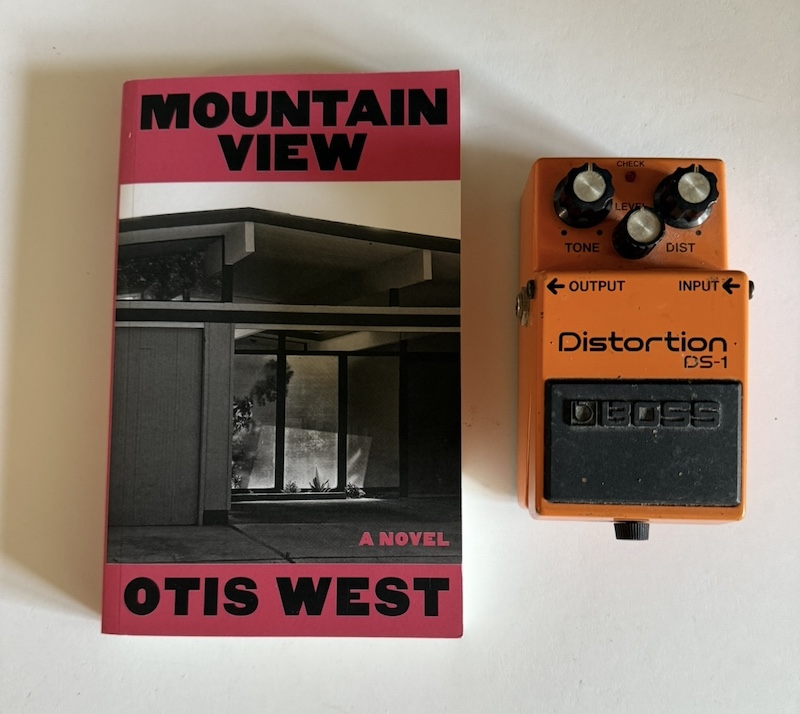
Mountain View is set during the summer of 1988. That same year I walked into The Starving Musician in Santa Clara and bought a Fender Mustang and this Boss DS-1 to use in the garage/punk band I was playing in.

A year later Kurt Cobain would make that same combo famous on Bleach. I managed to see Nirvana in SF at the Kennel Club in 1990 when they came through with Tad and Dickless. Full set here:

Learn more about Mountain View

Ibanez Tube Screamer

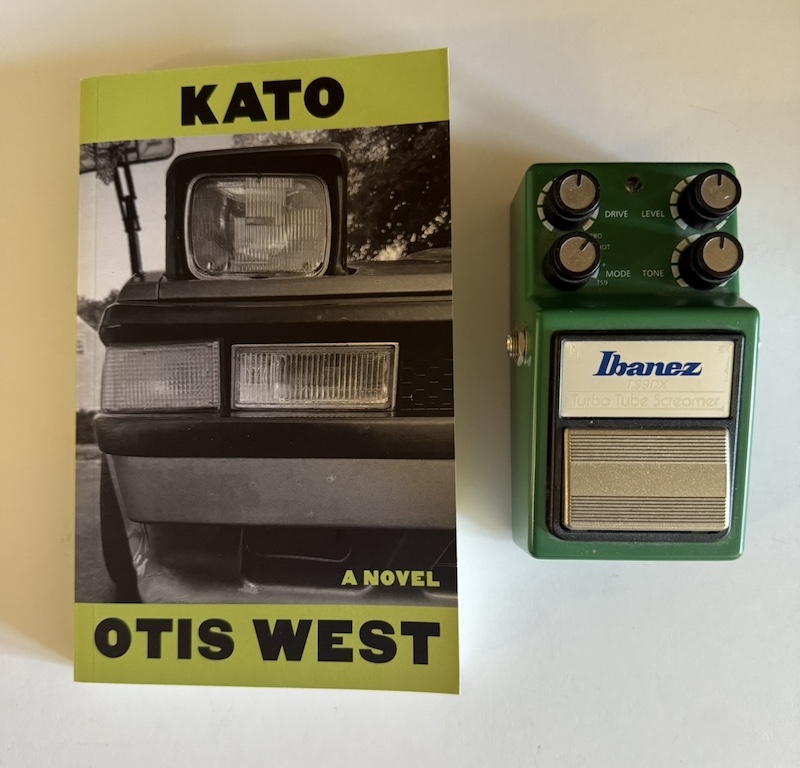
The Ibanez Tube Screamer is mentioned on page 10 of Kato:

The room was literally crammed wall to wall with band equipment. … There were two giant Marshall stacks, numerous sticker-covered guitars and basses, a few duct-taped mic stands, a PA and a battered-looking four-track. The floor was covered with cables and cords and various distortion pedals (on my first trip downstairs, I’d practically twisted my ankle on a bright green Ibanez Tube Screamer pedal).

Learn more about Kato

New Deal Danny Sargent 

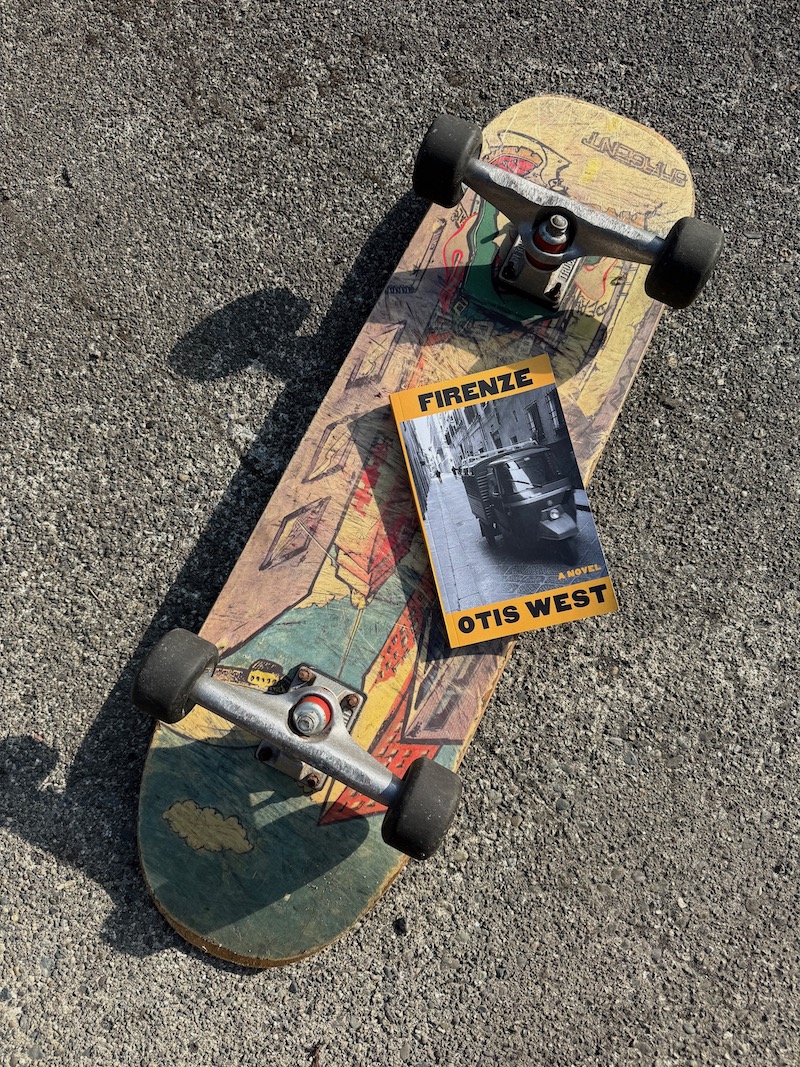
In Firenze my narrator arrives in Florence Italy in the late 80s “armed only with a skateboard and a poor grasp of the Italian language. What follows is a deadpan comedy about culture shock, family baggage, and growing up by accident in a foreign country.”

Pictured is the Firenze paperback with an early/mid 90s New Deal Danny Sargent (discarded by my brother’s friend) paired with my old Indy trucks and OJIIs. I did most of my skating in the 80s and had wanted to try this whole new double-kick tail thing out.

I recently found some of my old 80s Schmitt Stix decks in my parents’ shed so maybe I’ll post those later.

Learn more about Firenze

Paddle to the Sea: The 1966 Short Film Every Gen X Kid Remembers

Toward the end of Mountain View there is a section describing a short movie I saw in elementary school called Paddle To The Sea.

I’ve been surprised by how many people have commented about the Paddle To The Sea section. Mostly Gen X folks. So maybe the movie was more widespread than I thought. The movie was originally made in 1966 and I probably saw it in second grade in the mid-70s.

Have you seen it? Did it make a big impression on you? I really captured my imagination at the time and I still think it’s pretty great.

The movie is on YouTube:

Learn more about Mountain View