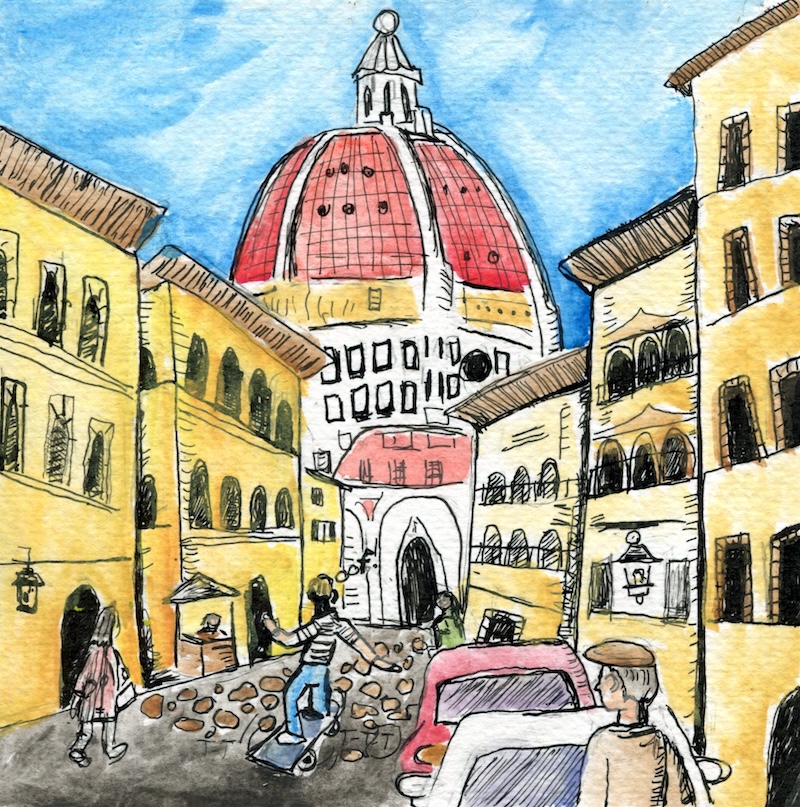
Thrasher Magazine in the 1980s: Skateboarding Culture and the Novel Firenze

In Firenze, our hero Kevin takes a latest issues of Thrasher with him to Florence. And since it was the 80s and there was no internet, he reads Thrasher over and over for much of the book.

I was bored. Normally I’d just watch TV or something. I didn’t really know what to do. I’d brought along the latest issues of Thrasher, which I’d already read twice on the plane. What the fuck, I’d read it again.

This issue had Tommy Guerrero on the cover. Looking through the article I got homesick. Tommy was from SF. He was my hero. I’d seen him skate once in Oakland and the dude had blown me away.

I flipped through and read all the ads. Then I read Skarfing Material, my favorite column by Chef-Boy-Am-I-Hungry. If you remember the scene in Rocky where he drinks all those raw eggs, that’d kind of like a Chef-Boy-Am-I-Hungry recipe, except he’d maybe add something to the eggs first, like hot sauce and peanut butter. Each recipe was preceded by an existentialist rambling of some kind. Chef-Boy-Am-I-Hungry had a recipe for a Squid Eyeball Sandwich and Vito’s Vittles. After the nasty dinner with Sr. Gasperi they both sounded pretty good.

Pic via ThrasherMagazine.com

Learn more about Firenze

Italo Calvino on Writing and Memory

In getting ready to publish Firenze, I revisited some of my favorite Italian writers, including Italo Calvino. I picked up a copy of his first novel The Path to the Spiders’ Nest and was particularly struck by a few passages in the the preface, which Calvino wrote years later when revisiting his early work.

What you read and what you experience in life are not two separate worlds, but one single cosmos. Every life-experience, in order to be interpreted properly, evokes certain things you have read and blends into them. That books always derive from other books is a truth which is only apparently in contradiction with the other truth, that books derive from practical existence and from our relations with other people.

There is another point: for those who start writing after one of those experiences that leave you with ‘so many things to say’ (the war in this, and in so many other cases), the first book instantly becomes a barrier between you and that experience, it severs the links that bind you to those facts, destroys your precious hoard of memories – a hoard in the sense that it would have become a reserve on which to draw permanently if you had been patient enough to husband it, if you had not been in such a hurry to spend it, to squander it, to impose an arbitrary hierarchy on the images that you had kept stored there, to separate the privileged images, which you believed contained a genuinely poetic emotion, from the others, those which seemed to concern you too closely or too little for you to be able to portray them; in short to set up in your arrogance a different memory, one that has been given another shape instead of your whole memory with its blurred outlines and its infinite capacity for retrieval… Your memory will never again recover from this violence that you have done to it by writing your book.

Learn more about Firenze
MXR Distortion+

How do you pair a distortion pedal with a novel set in Florence, Italy? Here’s how:

One night our hero Kevin misses the last bus home after being out at the bars. So he pops Zen Arcade into his walkman and walks back home through the cobblestone streets.

Bob Mould was known for plugging his MXR Distortion+ straight into the mixing board, a trick he likely used while recording Zen Arcade back in 1983.

From Wikipedia: As their EP Metal Circus was being released, Hüsker Dü entered the Total Access Studio in Redondo Beach, California to record their next album with SST producer Spot. The band recorded 25 tracks, with all but two songs (“Something I Learned Today” and “Newest Industry”) being first takes, in 40 hours. The entire album was then mixed in one 40-hour session; the entire album took 85 hours to record and produce and cost $3,200.

Learn more about Firenze

New Deal Danny Sargent 

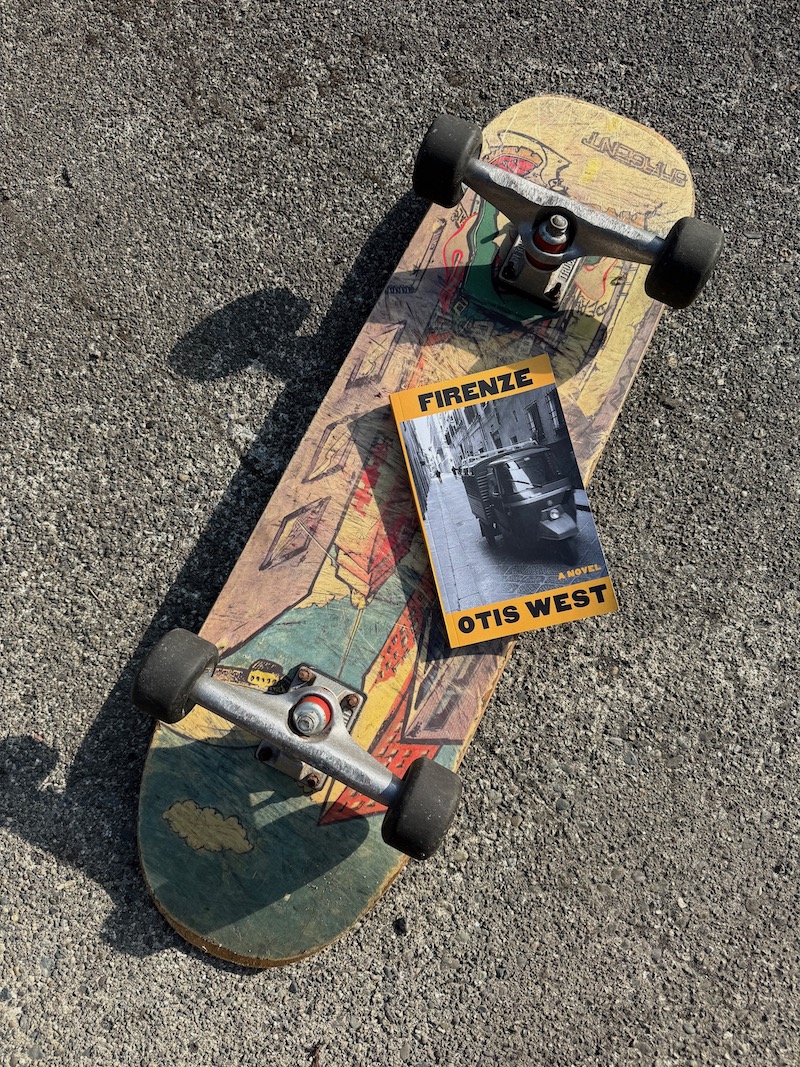
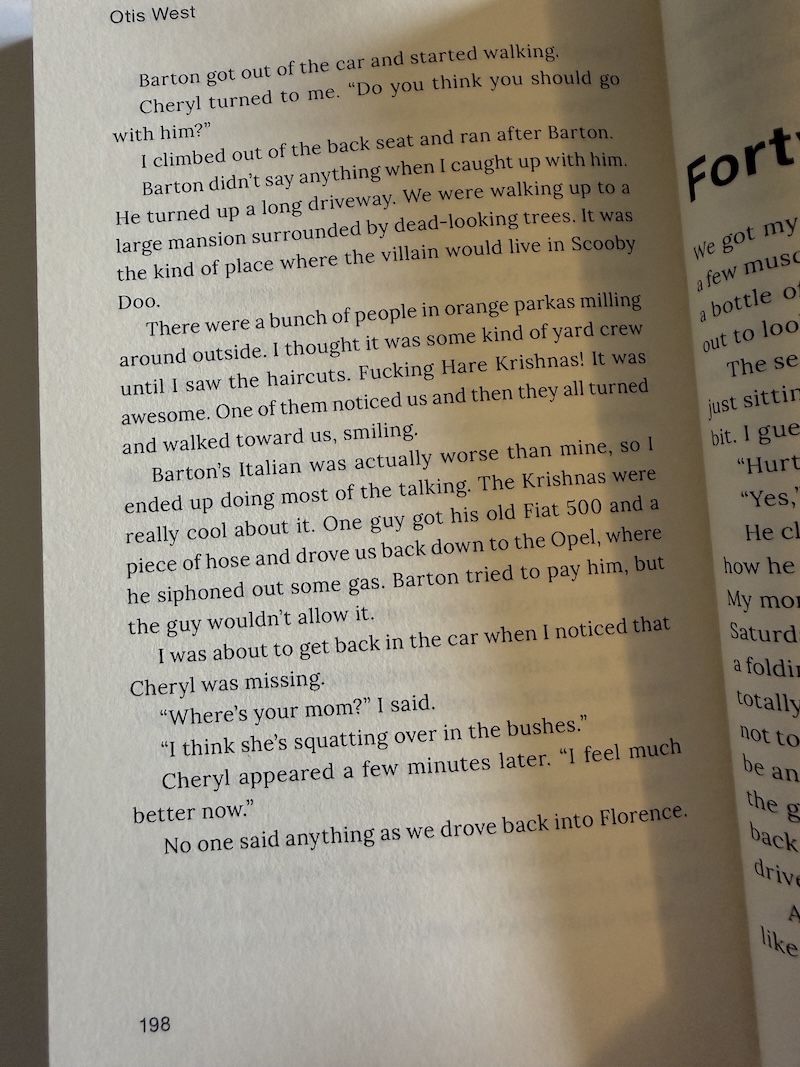
In Firenze my narrator arrives in Florence Italy in the late 80s “armed only with a skateboard and a poor grasp of the Italian language. What follows is a deadpan comedy about culture shock, family baggage, and growing up by accident in a foreign country.”

Pictured is the Firenze paperback with an early/mid 90s New Deal Danny Sargent (discarded by my brother’s friend) paired with my old Indy trucks and OJIIs. I did most of my skating in the 80s and had wanted to try this whole new double-kick tail thing out.

I recently found some of my old 80s Schmitt Stix decks in my parents’ shed so maybe I’ll post those later.

Learn more about Firenze

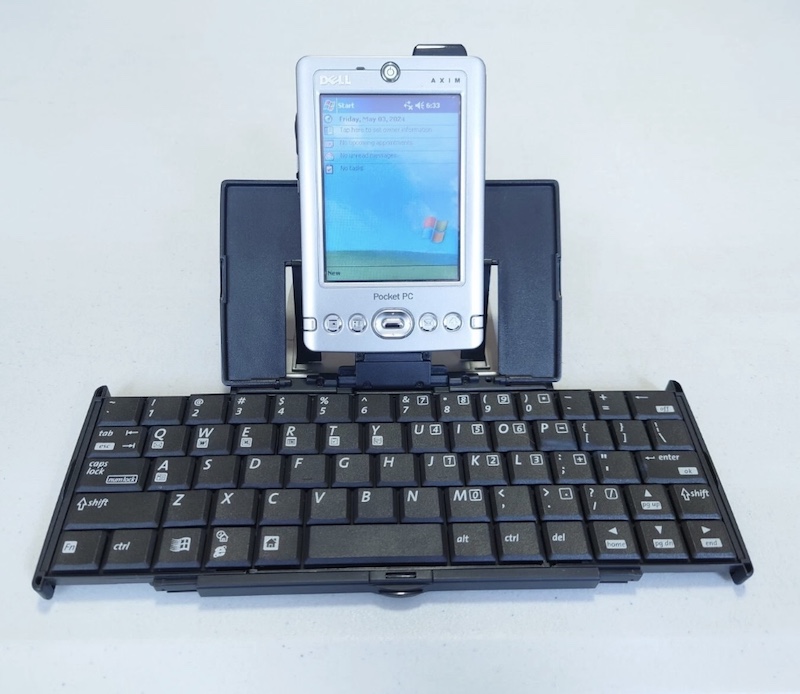
I wrote Firenze on a Dell Axim X3

I wrote Firenze on a Dell Axim X3 with the Think Outside Stowaway folding keyboard. I wrote most of the novel on my lunch break in the Columbia Tower atrium in Seattle around 2003/2004. The Axim had a “Windows Mobile” operating system and I’d connect it to my big old PC each night at home and download what I’d written that day. 

Those were not the easiest times for me. I was a new father and sleep deprived. The dot com bubble had burst after 9/11 and I’d traded my cool remote dot com jobs for a soul crushing corporate job. I was having some doubts about giving up California for rainy Washington State.

I’d written Mountain View with extreme optimism. A desire to get that awkward period between adolescence and adulthood down on paper before I forgot what it felt like. I probably sent it to 100 agents. Got a lot of requests, a lot of very nice letters back from some big names in publishing. I wrote Kato shortly after moving to Seattle from San Francisco in a kind of furious/fuck it, I’ll just write something jokey and fun. But then I was told by people close to me it didn’t have a chance in the publishing world at that time. So I sat on it.

Then life happened. I had this idea about not being able to appreciate things in the moment. I had some other ideas I was still turning over in my mind from both Mountain View and Kato. But Firenze was a struggle–I had so little time to work on it. On this funny little device and folding keyboard in this big bustling atrium. Wearing corporate casual–khakis and a blue button up. Getting texts on my Nokia 3310. 

I was definitely listening to a lot of Radiohead back then. Hearing Amnesiac takes me right back to that time and place. 

Learn more about Firenze